
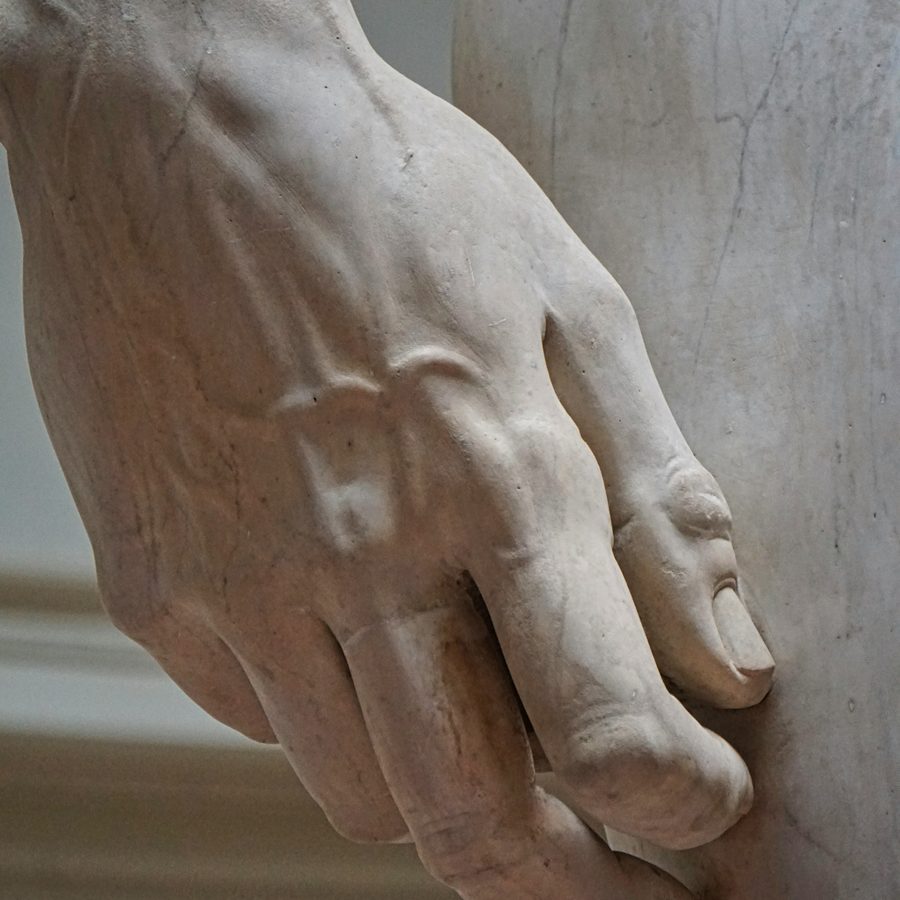
Researchers put the number of recognised Italian gestures at around 250. You need about twenty to follow a conversation, and knowing them improves comprehension more than the equivalent effort spent on vocabulary.
The everyday twenty
- Fingertips together, pointing up, moved up and down. The famous one. Not "delicious" — it means what are you talking about?, or "what do you want?", depending on force.
- Index finger screwed into the cheek. Delicious. This is the one people think the first gesture means.
- Flat hand, palm down, waved side to side. So-so, more or less.
- Chin flicked upward with the back of the hand. "I don't know" or "I don't care", depending on the eyebrows.
- Both palms up, shoulders raised. What can you do. Resignation.
- Hand chopping the other palm. Enough, stop, absolutely not.
- Index finger and thumb pinched, drawn across the lips. Say nothing.
- Finger circling the temple. You are mad.
- Two hands pushed forward, palms out. Calm down.
- Fingers brushing under the chin outward. Get lost, mildly.
- Thumb and forefinger rubbed together. Money.
- Pulling down the lower eyelid. Watch out, be sharp.
- Tapping the wrist. Hurry up, what time is it.
- Index finger raised and wagged. No, don't.
- Hands clasped and shaken toward someone. Please, I'm begging you.
- Arms folded tight with a tilted head. I'm waiting, and I'm unimpressed.
- Flat hand tapped on the stomach. Hungry.
- Thumb tipped toward the mouth. A drink.
- Fingers of both hands spread and shaken. Panic, chaos, disaster.
- A slow, single nod with lowered eyelids. Yes, obviously, and stop asking.
Gestures are not there to help foreigners. They are a parallel channel, and half the meaning of an Italian argument is in the hands.
The two to avoid
The corna — index and little finger extended, like horns — is a serious insult when pointed at a person, though it is also a good-luck charm pointed downward. And the ombrello, a fist with the other hand slapped into the elbow, is thoroughly obscene. Neither is something you want to do by accident at a football match.
Why it matters for learners
Because gestures do disambiguation work. The same sentence delivered with the chin flick and with the pinched fingertips means two different things. Watching the hands is one of the fastest ways to follow speech that is going slightly too quickly, which is why we work with film in the culture course rather than audio alone.